





AI Build Sprint / 10 business days

We build working AI with your team in 10 days.

Bring us one product or workflow, and our senior builders ship it with your people while your team learns to build the next one.

30 minutes. No prep. You talk to a builder, not a salesperson.

Clients & where our team has delivered

  • + more under NDA

Clients under NDA appear without a name or logo. References are available privately on request.

Why AI stalls

Most AI work stops short.

Three ways AI work stops short: the pilot never ships, the consultants leave slides, and nobody on your team can run the tool. We build the real thing, with the people who will run it.

The pilot works. Then it never ships.

The consultants leave slides. Nothing gets built.

The tool shows up. Nobody on your team can run it.

We build the real thing, with the people who will run it.

What you get

On day 10, you have three things.

On the Governance and People tracks, the thing you get is a working policy or program, not software.

your-productIn use
SourcesYour CRMYour docs
Draft replyDraft ready for review.
ApproveEdit

A working product, in use.

Not a demo and not a prototype. The people who will use it put it to work on real tasks while we watch, so what you get has already survived contact with your team. Every step that matters has a person approving it.

A team that can build the next one.

One of your people builds with ours, in your tools, on your data. How much they build depends on how technical they are. By day 10 they know how it works and why, so they can fix it, extend it and start the next one without us.

your-company/your-productdocs
  • src/
  • docs/
  • README.md
  • docs/how-it-works.mdwritten
  • docs/setup.md
  • .env.example
Handed over, keys included

The code and docs. Yours.

The repository, the setup notes and every login are handed to you. How it works is written down in plain language, so a new hire can read it. Nothing to renew with us, and nothing that stops working if we leave.

The 10 days

Ten days from kickoff to hand over.

  1. D01: Discovery with your sponsor and the people who will use it. We confirm what “working” means and who checks it.
  2. D02: We map the work and lock the scope. Your builder works with ours, in your tools, on data you approved.
  3. D03: Build day. You see it grow, not a status report.
  4. D04: Build day. Key calls go to your sponsor.
  5. D05: It goes live. Real users put it to work while we watch, and we write down what they find.
  6. D06: Iteration starts. We fix what real users found on day 5.
  7. D07: Iterate. The docs get written with the code, not after it.
  8. D08: Iterate. Your builder works with ours.
  9. D09: Iterate. The day 1 list is the checklist.
  10. D10: Final demo and hand over: the product, the code, the docs and the keys. We check it against the day 1 list together.
D01

Discovery with your sponsor and the people who will use it. We confirm what “working” means and who checks it.

D+30One hour together to see how it's going.

Four tracks

Pick the kind of work. Meet who leads it.

Product

Take a prototype to production, or build a new product.

On day 10: a product real users have already tried.

Led by John Ellison, with Chetan Nandakumar

Workflow automation

Agents take the repeat work. Your people stay in charge.

On day 10: the workflow runs on real work, and your people approve what it does.

Led by Abe Isleem

Governance & policy

Clear AI rules your teams can follow, and people ready to approve new AI use.

On day 10: your AI rules in writing, and the people who approve new AI use.

Led by Stephan Ledain

A facilitator sits in a circle of colleagues around a table of sticky notes and a Leadership Alignment sheet in a bright room

People & culture

AI fits the work your teams already do, and they have the skills to use it.

On day 10: a working program that fits AI into each team's real work.

Led by Fatma Ghedira

Work we've shipped

Real builds. Real outcomes.

For a 70-person UK insurtech: two working prototypes in two weeks

assist.client.vibrana.ai/calls/live
Real-time scoringCall #LC-88421 · Marcus T.
Call quality
82
/ 100
Compliance
74
/ 100
TCF alignment
88
/ 100
Call script guidance
  • Verify identity
  • Confirm renewal terms
  • Disclose cooling-off rights
  • Offer complaints path
Compliance nudge: Cooling-off rights not yet disclosed, required before payment discussion closes.

Insurtech

5% → 100%

of calls now reviewed

A UK insurtech: in two weeks we built two working prototypes, AI call reviews and a knowledge assistant.

Interfaces recreated for illustration.

Is this for you?

For you if:

  • You already use AI and want a real product from it.
  • You have one product or workflow in mind.
  • A leader can make calls fast.
  • Someone on your team can build with us.

Not for you if:

  • You want a slide deck or a strategy memo.
  • You want AI training with nothing built.
  • Five teams need to change at once.
  • We can't get access to your tools and data by day 1.

The team

The people who build with you.

  • 16 years building software. Built and exited two companies.

  • AI PhD from UC Berkeley. 10+ years launching AI products.

  • Senior AI engineer, 8+ years, formerly at Microsoft.

  • EU AI Act specialist. Founder of AdaptAI.

  • Organizational psychologist. Has worked with Google, Snapchat and the World Economic Forum.

Pricing

One fixed price, agreed before you start.

Sprints from $15,000

Fixed price agreed before you start.

Not ready for a sprint?
Workflow Triage: 2 to 3 days, from $3,000, credited to a sprint you book within 30 days.
After the sprint:
retainers from $3,000 a month.

All prices in US dollars.

Questions we get asked

  1. 01How much does it cost?

    Sprints start at $15,000. We agree one fixed price before you start, so there are no surprises.

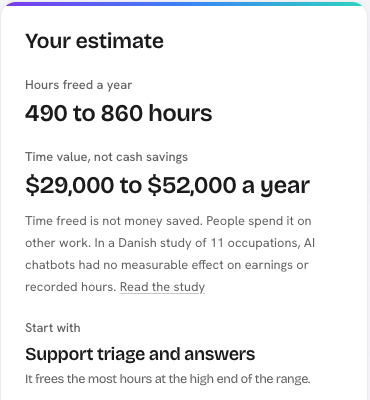
    Model a two-year program for your company
  2. 02Who owns what you build?

    You do. You keep the code, the docs, the setup and the logins. We list anything run by a third party, and what it costs, before you sign. You never have to keep paying us.

  3. 03How do we agree what “working” means?

    Before you sign, we write down what it must do and who checks it. On day 1, we confirm that list with your team. On day 10, we check the work against it together.

  4. 04How much of our team's time does it take?

    One person from your team builds with us. How much depends on how technical they are. Your sponsor joins on day 1, for key calls, and on day 10. You see the hours for each role before you sign.

  5. 05Is our data safe?

    We only use data you approve. Before we start, we list every AI model and service that will touch it, and where it runs. If we can't meet your security rules, we won't take the sprint.

  6. 06What if it isn't done by day 10?

    We agree the scope before you sign and keep it small enough to finish. If something we agreed isn't working, we fix it inside the sprint. You never have to buy more work to finish what we agreed.

  7. 07What happens after day 10?

    Your team runs it. Thirty days later, we meet for an hour to see how it's going. After that, you can stop, or keep us on a monthly retainer. It's your call.

  8. 08Has anyone else run this format?

    Yes, Uber. Its Agentic Pods pair an AI engineer with a finance, legal, HR or marketing expert for two weeks to build together. Uber isn't our client. Our sprints follow the same shape.

    Read the Uber CTO's post

Free, no call needed

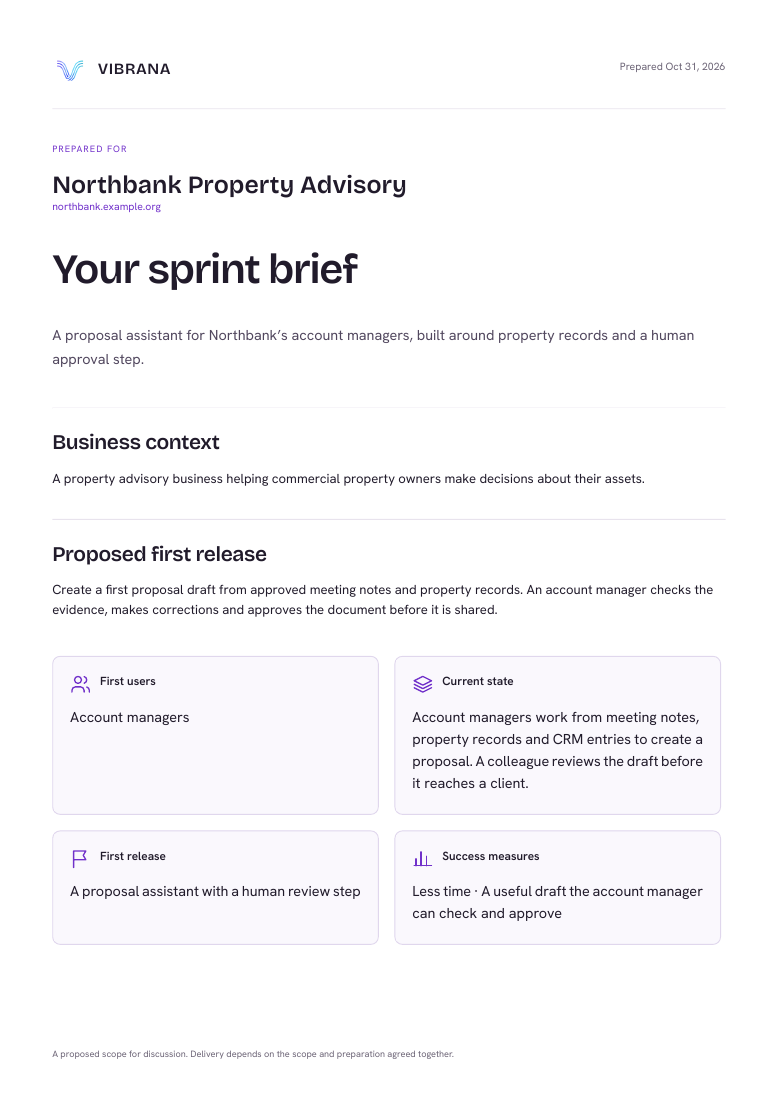
Build your sprint brief.

Answer a few questions about what you want built. You get a clear brief: the first release, who uses it, how you will know it works, and what to prepare. A copy lands in your inbox, and you can bring it to the call.

  • The first release, scoped
  • How you will measure it
  • What to prepare before day 1
A sample sprint brief: the company, the proposed first release, first users, current state and success measures

“Tell me your big hairy audacious goal, and we’ll decide what we can build in 10 days.”

John Ellison, Founder